Episode Transcript
[00:00:08] Speaker A: So welcome to the latest episode of the Dealmaker Uncut podcast, powered by Alvarez and Marcel. My name is Chris McGuire and I'm the executive editor of Business Cloud. As always, I'm joined by the multiple award winning dealmaker himself, Jonathan Boyers. Jonathan's been involved in deals totaling billions of pounds during his long and illustrious career and he's managing director and and head of Alvarez and Marcel's corporate finance practice in the uk. Hello to you, Jonathan.
[00:00:31] Speaker B: Hi Chris.
[00:00:32] Speaker A: Now this is a podcast that gets you inside the deal. In the first part of today's show, we're going to be interviewing our special guest and I can't wait for that after then we'll have a short break before Jonathan leans into his 35 plus years of experience in the world of corporate finance to answer listener questions in part two. So Jonathan, I know you've been excited about this. Who are we speaking to today?
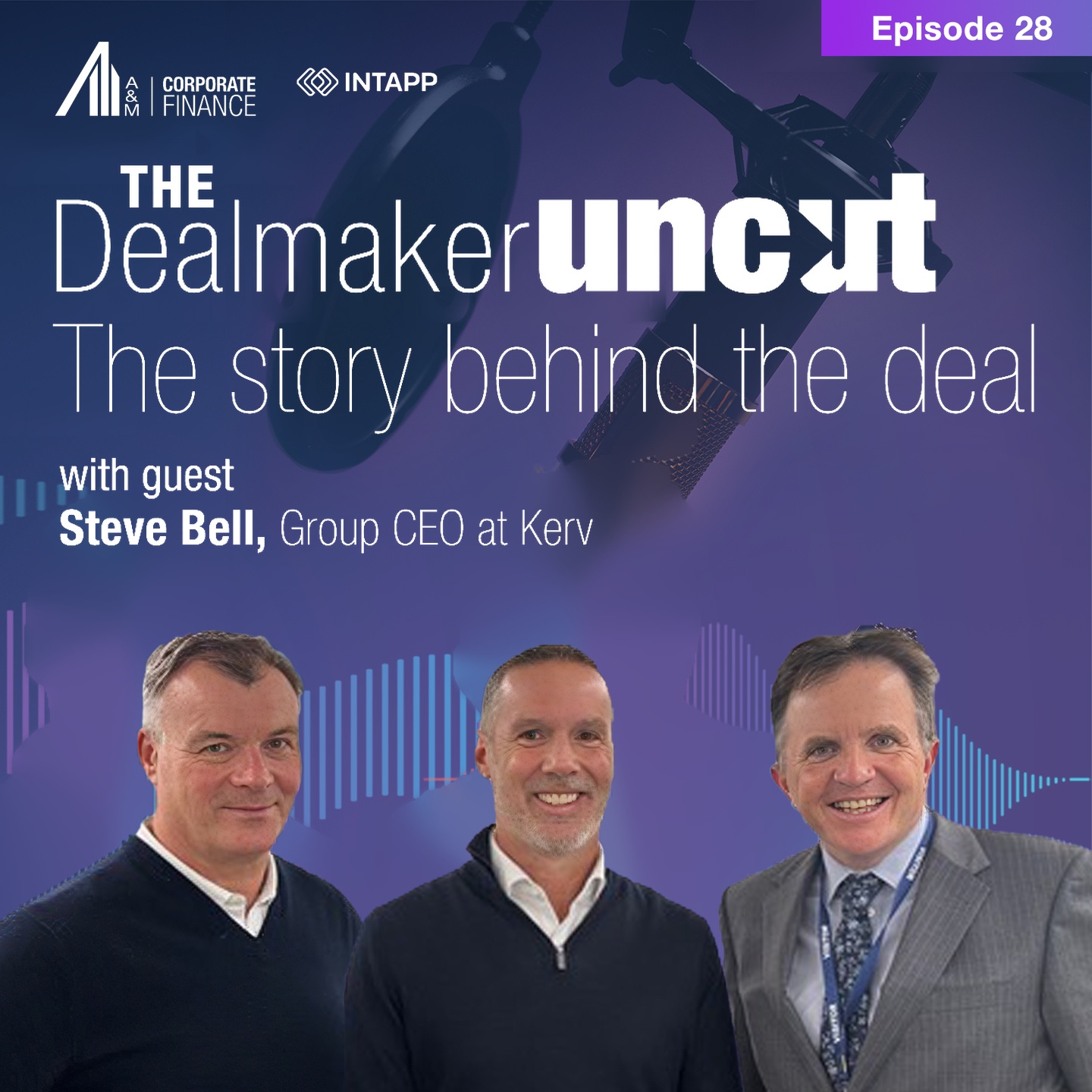
[00:00:51] Speaker B: Thanks, Chris. Well, today's guest is very experienced in doing deals. He's the CEO of private equity backed digital consultancy Curve.
But he's had a range of different experiences in the corporate world. So he was the co founder of Iris Worldwide, which he did sell and he then became the CEO of a listed gaming business called Everplay Group and then earlier this year he became the CEO of Curve. So welcome. Steve Bell.
[00:01:26] Speaker A: Feels a bit like this is your life, actually.
I'm going to start by asking you a question which is nothing about you. And I think sometimes it can be hard following in the footsteps of parents, especially when their parent, or their dad in your case, played for Arsenal. Your dad, Alan, played for Arsenal for six years, didn't he, in the 60s? I think
[00:01:44] Speaker C: he did, yeah. He left school at 16, was a very good footballer, was picked up by Arsenal, stayed there for six years.
He was then injured and then realized that he had to go and earn a living for the rest of his life rather than kicking a football around. So went back to college and ended up as managing director of Duracell. So he had a very good corporate career as well.
[00:02:05] Speaker A: But people forget like, like Tom Finney, you know, he had to, I think he became a plumber or electrician or something after his football career. People had careers after their, after their football stopped.
You were a talented footballer yourself. Much too modest to admit it though. And you also international gymnast and your son I think is quite a talented football. Well, and that was all before you founded Iris worldwide in your mid-20s. What was the ambition for Iris when you started it and what did your fellow founders, what was their vision for it.
[00:02:37] Speaker C: So we started Iris in 1999.
I was 27 years old, started my career working within one of the big networked agencies, publicists, and really, really enjoyed it. Really enjoyed the whole area of advertising, marketing, consumer behavior, understanding what's going on in people's minds and trying to make them understand what brands they could or should be buying into.
The problem came about probably after three or four years when you're working within a big corporate. It just didn't feel as though it was entrepreneurial enough. It didn't feel as though it was fast moving. It didn't really feel as though there was the right amount of reward for the people that were really making a difference.
And I remember it vividly. We had a night out. We were told what our bonus was going to be for the year within the business, and it was about £200. And we looked at each other, sort of the founders of Iris, not that we knew that we were going to found an agency. And we said, there has to be a different way. There has to be a way. We've just worked 12 months and we've worked really hard and we've grown customers and we've done incredibly well.
And we went out and that was when IRIS was born. In terms of an idea, we said, what if we set up an agency where we would be quicker, we would be more senior, we would be better than the corporate sort of dinosaurs that we were working within.
And that took us about 12 months from that moment where we went out for a few beers after our bonus to actually create an agency in the marketplace and in an oversupplied market, it's not as if there's not hundreds of agencies out in the marketplace.
So we needed to do something different. We needed to position ourselves differently. We just had a different vision for what a marketing agency could and should be.
[00:04:23] Speaker B: So you grew IRIS to more than a thousand staff, and I think you made about seven acquisitions, something like that.
[00:04:30] Speaker C: That's right.
[00:04:32] Speaker B: Could you just talk through that journey, the approach, how you went about the acquisitions, how you found them? Just give an overview of how the M and a bit worked in that growth.
[00:04:41] Speaker C: Yeah. So we realized, and we didn't acquire for at least six or seven years into our journey because to start off with, we were just very capable of finding very talented people in other agencies that we could bring into the world of IRIS to grow certain disciplines. We then started thinking about international and we then started thinking about certain disciplines that you couldn't just grow yourself or if you were going to grow Yourself, it would take three, four, five years.
So we were very strategic in terms of areas we wanted to be in the world geographically, and also disciplines that we wanted to grow into, because we knew that the clients that we were working with were requesting these on a day to day basis.
So the main acquisitions that we sort of undertook were either geographical or discipline focused.
So it was an interesting sort of process that we went through because we spent as much time, if not more on cultural integration and cultural due diligence than the commercials, because it was just really important that we had created this very special culture within iris.
We knew what we stood for, we knew what we believed in. It was around trying to make sure that we were all having this journey that we wouldn't get in a big network.
So the acquisitions were relatively straightforward. We knew we wanted to be in certain parts of the world.
We employed somebody to actually go out and find those businesses for us. And I remember on a number of occasions going out and meeting 15 different agencies over a four day period.
And you just get a feeling, you get a cultural feeling as to. I feel as though I could work with these people.
And then the commercials almost came second to that. Yeah, we wanted to make sure that we were doing the right deals and we weren't paying ridiculous multiples.
But it was as much, if not more, about the people and the product and the customer and client relationships that those businesses had.
[00:06:38] Speaker B: And how did you fund the acquisitions?
I've heard mention of a funding line from bank of Scotland, but how did you fund the acquisition?
[00:06:49] Speaker C: Yeah, it was an interesting process actually, because the bank of Scotland ran an entrepreneur's award every year and it was almost like the Dragon's Den where you'd go in there, you'd present your business, you talk about your ambition, you'd talk about the history behind the business and also where you feel, feel as though the business could go.
And it was for £5 million interest free. And it was one of those things that we thought we would do because it would be a bit of fun. We didn't think we would have a chance of winning this award. We went to a black tie event and IRIS was called up on stage as the winner of £5 million interest free. That 5 million very quickly turned into £10 million interest free because the bank of Scotland were very keen sort of jump on the IRIS bandwagon and grow the business with us.
So that certainly helped. But it also allowed us to make mistakes that we wouldn't have made if we hadn't have had that £5 million. Because suddenly you've got money and you feel as though you have to spend it and you don't go through the due diligence that you would have gone through before. We thought international expansion was the right thing to do. So we suddenly had offices all over the world where we hadn't really thought about the principles that made Iris great, which was we would set up if a client wanted us to work in a certain market. So you almost have the backing of a client, so it's relatively risk free to go into that market.
We then just started thinking, well, it'd be good to be in Spain, wouldn't it? That seems like a good market. Why don't we set up an office in Spain? Why don't we set up an office in Germany? Why don't we go to North America?
And we didn't have the backing of the clients. We didn't really know what we were doing. We were spreading the DNA that we had within Iris so thinly across the entire business and it came back and bit us on the backside, to be honest with you. And then the bank of Scotland said, right, can we have some of the money back now? And it was a case. Oh, we forgot it was a loan. We thought you were giving us the money. And I'm exaggerating to make the point, but suddenly we have to start making repayments. You have to start thinking about the mistakes we've made and the return on investment we were getting in a lot of the businesses that we had either acquired or set up around the world.
[00:08:55] Speaker B: That's really interesting.
So Meredith Corporation then invested in the business and then subsequently you bought them back out. Can you just talk about. That's an interesting little escapade. Can you just talk about that?
[00:09:11] Speaker C: Yeah. We knew that to fulfil our ambition, investment was going to be an important part of the journey. And Meredith were quite left field, really. So they're an American business.
They are a hugely successful American business. They have television channels and magazines and they're a publishing business, in very simple terms.
And we were introduced to the guys at Meredith, the corporate development team at Meredith, and suddenly it started to make sense. They were very big in the us. US was one of the biggest, if not the biggest, advertising and marketing spend market in the world.
They were huge out there, had huge amounts of client relationships that we could potentially tap into. We were very big in Europe.
They had a real interest in terms of shifting the dial with some of their customers and how brand communication could actually work.
So on paper, it seemed like an amazing partnership. They bought a small percentage of Iris and there was a plan for them to continue to acquire over a period of time.
The.
You could say the investment went well. It went well from our perspective because they were relatively hands off. Didn't really want to get that involved in the business because they're a multi billion dollar organization. At the time we weren't anywhere near that, that size.
So it felt, and I've spoken to a number of people about this and they said, well, it's a dream, isn't it? You've got the investment funds, they're not marking your homework, they're not really getting involved in board meetings.
But in the same way that they weren't getting involved in that, they weren't really making our business any better.
They weren't teeing up the opportunities that we wanted in North America. They weren't giving us the business guidance that we probably needed because we were all very young when we set IRIS up. We were all in our 20s. So it's not as if we had decades of experience of running P and LS and really understanding how agencies worked. So it was good in the sense that it gave us an opportunity to use that investment.
It was bad because I don't think Meredith made us a better business than we were if we hadn't of joined forces with them. And after a couple of years it just sort of. We had the decision do we want to sell another chunk of the business to Meredith or do we want to buy Meredith out of that? And that felt like it was the right thing to do. We always had the view that we wanted people who had equity in our business to have an active, engaged role within the business.
[00:11:40] Speaker A: They were passive, were they?
[00:11:41] Speaker C: They were very passive.
They were very passive. Really good guys still got on very well with all of them. They've all gone on to do incredibly well within Meredith or outside of Meredith. But it just didn't feel as though it was the right long term home for Iris. And I think that was a really important point for us.
[00:11:59] Speaker B: So you brought them back out and then the business then grew nicely over 100 million turnover. And then you decided to sell the business to Samsung or division of Samsung.
What was the rationale behind that deal? What were you trying to achieve?
[00:12:21] Speaker C: Yeah, so there's the world of agencies.
I would say the majority of agencies will be acquired by either wpp, Omnicom Publicism, one of the big holding groups.
And having been in the world of advertising and marketing for two decades, you know, a lot of people that go through those earn out processes and suddenly the brand is changed, they're reversed into another part of WPP and you lose what's special about the business. And for us, making sure that IRIS continued in the way that we created, making sure that even though we may not have been there in the sort of the longer term, there was a legacy. That was a really important word for us around legacy.
So selling to one of the big holding companies just didn't feel as though it was the right thing to do. It goes back to what I said earlier around cultural due diligence and making sure that we realized where we would potentially be housed within an organization. So the big holding groups didn't work.
We looked at private equity.
Yeah, that was a potential route that we could go down. But the ownership of Iris was quite different as we matured.
And what we realized was for us to be credible and attract the best talent in the marketplace, we would need to dilute and actually give people equity, real equity within the business. Because if we set up in Singapore, we could take somebody from the Irish London office and put them out in Singapore, that would be fine. But Singapore is a very specific market and you would need somebody from the Singaporean market to really come in and join a partnership with the business. And the best way of getting the best people is by offering them equity within the business. So when we sold the business, there were over 60 equitable partners that were still operating and working within Iris, which is really unusual.
But we felt very strongly that that was the right thing to do. It wasn't about a few people getting rich quick. It was about making sure that we're taking people on that journey.
And we all know if people have equity within a business, they think they act in a different way. It is their business. And it wasn't just a we'll give you 0.001%. We were giving meaningful chunks of equity to people who would make a huge difference to that business moving forward.
[00:14:45] Speaker A: Jonathan's always been of the view that when it comes to selling a business and attracting investment, you know, people look for the strength of the management team. And if you have a management team who are invested in the business, you get the best business.
So there are earn outs, Steve, and there are earn outs. You had a five year earn out after you sold iris, which is incredible. The idea that you sell your business today and you're not going to leave it until 2031. I think most of our listeners and viewers will be spitting out their coffee as we speak. What was that experience like, and if you could do it all again, would you ever have another five year earn out?
[00:15:21] Speaker C: I think you've hit the nail on the head there as far as a five year earn out is not something that I would ever and have never recommended to anybody else.
[00:15:30] Speaker A: How old would you been when you sold Iris?
[00:15:34] Speaker C: I would have been 44 when we started, when we started the earn out.
[00:15:41] Speaker A: So 44 to just about to turn 50.
[00:15:44] Speaker C: Correct.
[00:15:44] Speaker B: And did you serve the full five? Did the full five year earn out okay. Just
[00:15:49] Speaker A: to benefit people
[00:15:50] Speaker B: listening, were you still in control of the business or had they taken control?
[00:15:54] Speaker C: No, we were still very in control of the business. And Samsung or Chail, because Chail is part of the Samsung Group, which is the marketing communications part of the group, they were very, very good during the earn out process. So they would be very keen for us to do more work with Samsung because that was their most significant client who was owning Chael and therefore owning Iris. But when it came to strategic decisions, when it came to hiring people investing in certain areas, they were very hands off, which was good and that was very important for us. But in answer to your question, five years is a ridiculous amount of time to be feeling that you're in an earn out process because you don't make some of the right decisions. I think for the business because you're thinking about ebitda, you're thinking about margin, you're thinking about revenue growth and the multiple of the business was born from those factors. So we needed to make sure we were delivering because we had over 60 partners who had invested a significant amount of their working life that we wanted to make sure were realising value and we wanted to make sure that we as founding partners were realising value as well.
But it becomes quite hard work after two years, three years, four years, and you're constantly making shorter term decisions based on EBITDA performance rather than mid to long term strategic calls that will make the business more valuable moving forward.
[00:17:26] Speaker B: You can get quite awkward misalignment with an earn out, particularly one that long at the longer end of the earn outs. I've seen when the new owner wants you to invest for the future and you want to pull back spending because you focus on profit.
[00:17:43] Speaker C: I think the other thing that was quite interesting was the earn out ended at the end of 2019, so 31st of December 2019. So then you go into 2020 and then Covid hits within, within three months. So from a shareholder perspective and the 60 partners that we had within Iris, obviously that was a really Positive thing. But it was very difficult for Samsung because we then went into, within three months, we went into probably the greatest shock in the advertising industry for four or five decades because clients weren't spending money, you weren't spending on marketing because people weren't going out, people weren't buying things, people were just hunkering down to get through the next however long. So
[00:18:32] Speaker A: I think we'll be talking about, we were doing this podcast in 10, 15 years and then it got to 1999, sorry, 2019 and 2020, and that was Covid. I just think it's going to be a period in our lives where it'll be, you know, X number of years since COVID And I don't think it's something you forget. Just for the benefit of our listeners, not the viewers of this podcast as well. When Jonathan was asking you that question, you know, almost incredulous, you did a five year earn out, you were nodding your head vigorously as well.
It probably wouldn't have come across, you know, to anyone listening as well.
You finally said goodbye. So you exited Iris and then we had Covid and you became the CEO of a listed gaming business called Everplay Group. I think it's fair to say. Actually, my insight into gaming is minuscule. I think it has a market cap of around 600 million. But you don't have a background in gaming. How did you find that transition going from a sector you knew really well to a sector you knew nothing about or not much about?
[00:19:30] Speaker C: I'll be honest, I wasn't phased about that at all.
And the reason I say that is having worked in advertising for 20 years, you are constantly learning and reinventing your knowledge base around certain clients that you may be working with. There are certain clients that you know more about. I'm into sport, so therefore working with Adidas at Iris for 15 years was a very simple thing to do.
Starbucks was a huge client for Iris. I don't drink coffee. I never really go into coffee shops. It's not really my thing. So getting under the skin of coffee culture and the way people think and the way that people act. So I've always been used to understanding about consumer behavior, target audiences, businesses, and therefore it didn't faze me at all.
The business side of Everplay, it just felt very natural. It felt a very natural thing because I think once you've learned how to run an organization, a business, a multinational business that had acquired a number of businesses at Iris, stepping into Everplay was a similar challenge. There'd been a number of Acquisitions, and those acquisitions on their own were hugely successful, but the whole wasn't greater than the sum of the parts. It almost felt as if it was a number of different companies that just happened to be owned by what was called Team17 at the time.
And then Team17 rebranded, we rebranded the business, which I thought was a really important thing, because I don't think you can have the name of the Topco, which is the name of one of the individual businesses, because it makes all the other businesses just feel as though they're peripheral to what's going on.
So I wasn't fazed by it. I probably underestimated the complexity that there is in the world of gaming, because in advertising, it's a professional service business, you're selling people's time or you're selling products within gaming, you're making considerable investment calls that will take 1, 2, 3, 5 years to develop.
And then you put them to market and then they might fly or they might die within 24 hours. And it's literally that quick. You know, whether you've got a runaway success or a game that's going to have to be impaired pretty quickly because. Because you just don't have the customer sort of satisfaction scores that you need to actually deliver that.
So that was a real eye opener. But probably the biggest eye opener was the fact I went from running a private company to running a listed company and the transparency and the governance and the procedural elements of that were significant.
I think it actually played to some of my strengths because used to delivering strategic guidelines, stories, understandings about businesses and sharing those with clients, and that's what was needed. Within Everplay, there needed to be a very clear strategy.
The shareholders needed to understand what that strategy was to enable them to believe in the company, which in turn allows for an uptick in share price as you go through. So understanding that that relationship that you have with your shareholders, where you have a roadshow every six months and you go deep on that roadshow and they ask you absolutely everything and anything and then the share price will go up. If you've built trust and they have an understanding that what you're doing is correct and that I actually really enjoyed within the listed environment.
[00:23:03] Speaker B: I suppose what you described is an uncertainty about whether a product is going to fly or not. If you've got a listed, the communication with your shareholders must have been quite challenging to get the expectations into the right place when you couldn't really know what the outcome was going to be of each launch.
[00:23:21] Speaker C: Yeah, I think that's right.
However, the thing about Everplay, and I'm not saying that all games, developers and publishers have this, but Everplay have a very high percentage of their revenues come from back catalog.
So these are games that have launched over the previous 5, 10, 15 years.
[00:23:39] Speaker A: Name a couple of the games that our listeners might be familiar with.
[00:23:42] Speaker C: Yeah, Worms was a huge game.
It's 25 years old now, Worms. So it's a huge, a huge franchise that is owned by Everplay. Hell Let Loose is a huge first person shooter game. They've just launched a game called War Dogs which has been the number one game over the last week and a half on Steam in the world. So they've got some sizable games, but they're more in the indie gaming space. So it wouldn't be a Call of Duty or a Grand Theft Auto where they spend a billion dollars and 15 years developing it. These are games that are lower investment, but when they capture the audience, they just absolutely fly. And with a lower investment level, the returns on investment can be significant.
But you're right in what you say investors like, they like predictability, they like to know where the money is coming from. And in a gaming world you can't guarantee anything, but what you can do is you can rely on your back catalog. You can work that really hard. Which means the lion's share of your revenues are relatively safe at the beginning of the year because you know your back catalog will deliver. And then it's very similar to a private equity or a VC fund, I would say, which is okay. We know if we're investing in 10 companies, three of them will do exceptionally well, five of them will do about what we thought and one or two of them might not deliver.
It's a similar type of makeup within the world of gaming where you know you're going to get, or you hope you're going to get a couple that just fly out of the blocks and that will prop up some of the downturns on lower performing games.
[00:25:16] Speaker B: So the share price grew and profit grew 40%, something like that?
[00:25:21] Speaker C: Correct.
[00:25:23] Speaker B: When did you decide that you'd gone far enough with that and how did you get out?
[00:25:30] Speaker C: For me, the Everplay role, it was very much a transformation role.
And that's how I viewed it. When I went in there. I thought it was an amazing business. I thought that the talent that they had within the business was exceptional.
But it never felt as if it was going to be the job I would do for the next five, 10 years. It just didn't, it didn't feel that the product itself was something that truly excited me and people find that quite strange because computer games are hugely exciting. It's one of those amazing things where the storytelling and the craft and the art direction and the style and everything that goes into computer games. But it didn't feel that I wanted to stay within that sector for the next chapter of my career.
I was so pleased that I did the listed business and I actually really enjoyed the listed business side of it.
I enjoyed what we delivered whilst I was at Everplay in terms of the share price, the trust in the shareholders, the strategy, bringing the business together.
But I think once you've run your own thing and once you've started something, you get a feeling. You get the feeling that, can I see myself doing this? And I'm the sort of person, if I can't see myself doing it in the midterm, then I want to find what I do want to be doing. And that's sort of where it got to after a couple of years plus with Everplay, I just felt as if I'd done what I set out to do. I was very proud of what we delivered, but it didn't feel as though it was the sort of place that I wanted to be. And I also think, if I'm being really honest with you, a lot of the structural and transformation work had been done.
It then needed somebody who was just an expert at computer games, somebody that was from the computer games world, who would be. Because it's more about just finding games then green lighting games and moving them forward. And that wasn't the thing that I was most passionate about.
[00:27:30] Speaker B: So I can see it must have been interesting and I can see why it would be enjoyable to lead a public company. A lot of people find it frustrating, but I can see why it's a really interesting thing to do.
You then moved on and did some board advisory work. You went plural for a while, but it sounds like you've done everything else, so you needed to work with a private equity investor as well. So. So do you want to talk about Curve and.
[00:27:59] Speaker C: Yeah, no, it's a good observation. And the plural sort of life that I led was. And I'll be honest, I thought that might be what I want to do. I just do a number of non execs.
I felt unsatisfied at the end of the week and I'm not used to feeling unsatisfied. You get into the Friday and you feel, it's been a good week, achieved this, or it's been a bit of a Crap week, because that's happened, what we're going to do next week.
I just didn't feel that, I didn't feel that within the.
[00:28:32] Speaker B: Was that because you weren't, you weren't gripping the business, you were sort of always consulting and dipping in and out, but not really doing anything?
[00:28:39] Speaker C: Yeah. And in time I will definitely go on and do that because there were parts of it that I thought were brilliant, really enjoyable and if you get the right portfolio, I think it can be a really satisfying thing. But I just felt, I felt too young. I felt as if I had too much energy. I felt as if I had ideas and I just wanted to, I wanted to go again. I've just got that thing about me where I talk quite a lot about frustrated ambition and in short, to anyone and they'll say, yeah, I'm ambitious, but I think certain people, whether it's an entrepreneurial thing or not, have that frustrated ambition. I've still got loads of frustrated ambition and feel as though I did want to go again. And private equity just really interested me. I really liked the fact that it was very clear and transparent around what you as a group CEO has to do. You have to create value, you have to make the company more successful, you have to retain talent, all the things that are important.
But you can do that in the midterm. It's not a case of, well, you've got a roadshow in six months time. We've got to make sure that we're exceeding expectations with the city. It feels a little bit more medium term, the whole, the whole world of private equity. I also know there are various private equity firms out in the marketplace. Some have very strong reputations and some less so. And it was really important for me that I was working with a leadership team from the private equity and the board perspective that truly believed in what Curve could be and can be moving forward and that I really liked and could learn from. And I definitely got that in Bridgepoint.
[00:30:16] Speaker B: So did you work with LDC before Bridgepoint?
[00:30:19] Speaker C: No, I didn't. You
[00:30:20] Speaker B: joined when Bridgepoint
[00:30:21] Speaker C: Curve was an LDC backed business and then LDC
[00:30:26] Speaker B: and you
[00:30:26] Speaker C: came in with
[00:30:26] Speaker B: Bridgepoint, did you?
[00:30:27] Speaker C: Correct.
[00:30:28] Speaker B: Okay,
[00:30:28] Speaker C: so Bridgepoint have held for about two years now.
[00:30:31] Speaker A: Steve, you've only actually been with Curve for six months at the time of recording this podcast.
And before you joined the business, Curve had embarked on a buy and build strategy. I sort of get the impression from having spoken to you that your first six months almost been consolidation and making sure that business is ready for the next stage of growth. Would that be fair?
[00:30:51] Speaker C: Yeah, I think that's right. And Curve has been incredibly successful in the marketplace. It's shown very good growth rates.
It's got some incredible businesses that have been acquired over the last five or six years.
I just don't think, going back to this point, I said earlier, in terms of the whole being greater than the sum of the parts, I just don't think we're realising the full potential of that business, because we've got some of the most amazing customers in the marketplace that want to go through digital, digital transformation, AI integration, cloud integration, all the things that are going on in the world of.
In the world of technology.
But we're not basically spotting the opportunities with those customers to be able to say, we could be doing this for you. And that doesn't mean we go into an aggressive sales strategy at all. But the offerings that we have within Curve are exceptional in so many different areas.
And I don't think we're working closely enough with our customers to be able to truly realize the value that we could be generating for their businesses moving forward.
So, yeah, it's making sure that we've got the right foundations for growth. It's not running around 100 miles an hour trying to acquire new businesses in the short to medium term. But there will be future acquisitions, there's no doubt about that. But it has to be strategic. It can't just be opportunistic. Oh, we've got this because we're buying it on a low multiple. Got to make sure that the strategy, the story makes sense. And that's something that I'm really excited about. I think the business is.
I really like the people. That's very important for me. Perhaps I didn't realize that before.
I like the product. I think the product and the services and the professional service and the strategy side of the business is fascinating.
And I think with Bridgepoint and the ambition that we have with the business, I think it's got so much potential.
[00:32:49] Speaker A: I don't think we could go an episode of this podcast without mentioning AI. There's been a lot of talk about it. You describe yourself as an AI optimist.
What does that mean? And where do you think AI will have the biggest impact on businesses like Curve moving forward?
[00:33:02] Speaker C: Yeah, I think everybody will pick up the newspaper, listen to podcasts, and you'll get an awful lot of headlines from very senior people within the world of AI, talking about stuff that we've all read. It's going to take over the world. No one will have a job in 5 years time, etc, etc, etc and you could suddenly get yourself in a downward spiral about AI. I look at the benefit that AI is bringing to Curve on a day to day basis, just in terms of efficiencies, how we're operating, how we're structuring ourselves and also more importantly how we're using AI to benefit our customers. And that's the thing that I'm most excited about. Customers are coming to us and said we're not really using AI, we're not an AI first organization.
And working with the likes of Microsoft and others to make sure that we're delivering the right solutions for the business. They need to be moving forward. There's something we've been talking about within Curve because some people say well, what's your AI strategy?
And it's quite a difficult thing to answer because we're a business that has AI running through our veins pretty much every minute of every day. And what we talk about is AI is what we, AI is what we do and AI is what we sell. It's basically it is what we are. So therefore you can't suddenly say well here's five slides on Curve's AI strategy because. Because every customer that touches Curve in one way, shape or form will be influenced by what AI is doing for them. And that's why I'm an optimist, because I can see the benefits, the efficiencies that it's creating for businesses and that's genuinely exciting.
[00:34:49] Speaker B: I think almost every private equity deal that happens over the next year or so, there'll be some form of AI due diligence.
I
[00:34:56] Speaker C: think they will. And they're sort of in the gaming world as well. Not surprisingly, every roadshow that I went through, the one consistent question within every single investor call was how is AI impacting the world of computer games?
And the benefit is AI is benefiting the world of computer games in terms of the build of games. But when it comes to the creation, the ideation around a great idea, AI can't do that at the moment. It will get there, I'm sure, but it's still something that I feel as though it has to be the blend of human skills, technological skills with AI. If you can get that blend together, then you've got incredible power. But I'm not somebody that signs up to some of the headlines that are saying that it's going to ruin everything about business. It won't be allowed to. Governments won't allow AI to suddenly create the levels of unemployment that it's talking about and yeah, I just, I can't see it
[00:35:55] Speaker B: happening. Doesn't seem like it, does it? So you've, you've been, you've done all of it, you've done private equity, you've done listed companies, you've worked for a corporate and you've worked for yourself. So which, which, which is your favorite? Which do you prefer?
[00:36:10] Speaker C: The.
It's a brilliant question actually, and I haven't really thought that someone would ask that. But the way that I tend to look at, I don't think there's a. I wouldn't say, oh, it's definitely private equity or it's definite listed.
The way I view my career and what I've done is little chapters of learning and I've always chatted about the importance of learning and that's why I purposely decided not to stay in advertising for a 40 year career. I could have quite easily said, well go there, I'll go to a big group and then I might set up again and I'll back someone else. And I just didn't want to do that because I wanted to continually learn. And I think every chapter in terms of private company, growing it, selling it, Working within the Samsung Group, one of the biggest companies in the world.
Fascinating. Spending a lot of time working within Korean culture as well. Again, a huge eye opener. Some amazing things and some things that I would never sort of include within corporate organizations and then working in the plc. So I couldn't answer the question. It was a really simple question. I've gone quite a long answer.
Well, no, it is, but I sort of take 20% of that, 30% of that, 40% of that. But
[00:37:25] Speaker B: you can enjoy them all.
[00:37:27] Speaker C: I can't. Did you say you can't? I can and I definitely look at the things that I did enjoy.
I genuinely feel as though the private equity side of it is getting the best out of me and I'm getting the best out of it just in terms of the type of business we are and where we can take it. And I'm really excited by that.
[00:37:45] Speaker A: It's worth saying. It's worth saying, Jonathan, that you spent a large chunk of your career at a big four accountancy firm. Now you've got Alvarez and Marcel and you've almost got a certain freedom that maybe you didn't always have.
[00:37:58] Speaker B: Yeah, I'm envious to hear that story because I did exactly what you mentioned you didn't do. I did stay for the 34 years with one firm and always doing corporate finance. And then I moved to another one and still doing corporate finance.
So I am envious of you having experienced all those different things. Obviously I touch all of those different areas all the time, so I do get some variety.
[00:38:25] Speaker A: So time for a quick break. When we come back after this short interval, we'll be discussing interview with you, Steve, and what we really think of you. And Jonathan will be answering some questions from our audience and also from myself. But thanks very much for your time, Steve.
[00:38:41] Speaker C: Thanks,
[00:38:41] Speaker B: Steve.
[00:38:41] Speaker C: I really enjoyed it. Thanks very much.
[00:38:47] Speaker A: Welcome back to the second half of the Dealmaker Uncut podcast. We've just interviewed Steve Bell, CEO of Curve. He's had a remarkable career, hasn't he, Jonathan, what was your view?
[00:38:57] Speaker B: So I just thought he's got a really fascinating breadth of experience.
He's obviously entrepreneurial, he set the business up in the beginning.
But having worked for all the different parts of the corporate finance world in listed company, private equity, and then obviously he took on Investron, then bought them back out again as well. He's done almost everything there is to do in corporate finance.
He just seemed like such a nice guy as well.
[00:39:23] Speaker A: Yeah, very level headed. I think the thing about Steve that struck me about him is that he doesn't settle for the easy life. He's always looking to improve and better himself as well.
It's interesting when he started taking those portfolio roles as an honest director, he was a bit unfulfilled on a Friday. Something I can relate to as well because, you know, I love the busyness and the variety in my life and I get to a Friday and I look back on the week and if I've not done anything, I get frustrated with myself. Completely different level to Steve, I hasten to add, but a genuinely, really, really nice guy as so many of the people are that we have on this podcast a great guest. This next section is called Ask Jonathan. It's where listeners can ask Jonathan any questions they want and I can fire a few questions in as well. This first question is how do I know what my business is really worth and how can I maximize what valuation before I sell? Also, will different advisors give me different valuations simply to win the mandate?
[00:40:17] Speaker B: Okay, so how do you know what your business is worth? Well, I mean a business, the theory behind business valuation is that it's worth the present value of all the cash flows that it's going to generate in the future.
And so valuation is just an estimate of that.
People will often apply multiples to an assumed earnings figure or a run rate earnings figure to try and Estimate what that discounted cash flow calculation would look like.
And a lot of people focus on what multiples have been paid for comparable companies, either in private transactions or what listed companies are worth, and what multiples are implied by the share prices. Then they apply it to their own company.
So that's the mechanical process. But often deciding what earnings figure to apply that to is probably the most difficult thing and probably the most important thing as well.
When you ask advisors what the business is worth, if it's a beauty parade, you might well get people slightly overestimating what they think they might get on the sale in order to try and secure the mandate. The reality is, working with an entrepreneur who's thinking of selling their business, you need to be sort of realistic.
It doesn't really help anybody if people think that businesses are going to be worth more than they really are.
But if you talk to a good, sensible advisor, you'll get a good idea of the range of valuations that might be achieved and how to achieve it. For both trade, private equity, maybe even ipo.
That's basically how you would do it.
[00:42:06] Speaker A: Second question, final question. Actually, I'm going through a sales process. I'm concerned about the impact of the business.
If the deal falls through, how do I protect the business and should I be worried?
[00:42:17] Speaker B: So the best way to make sure a sale process results in a sale is to prepare really thoroughly.
Prepare the business really thoroughly for sale so it's in as good shape as it can be.
The right management team, the right business plan, but also to get all the due diligence done up front. Prepare really thoroughly so the equity story is really strong so that you've identified any potential pitfalls during the process and then rectified them, if that's possible.
You might need to do technical due diligence and you might need to remedy anything that's found by that DD and then warm up the buyers. So often before a sale process actually launches, you'd normally have expected to have met some of the buyers, identified them, and in an ideal world, before you launch a process, you should know that at least two or three people are going to make you offers. You should have formed a relationship with the buyers so you could be in the the market for as short a period as possible.
And the name of the game, Even if you're running a two stage sale process, the name of the game is to make it so it's as short as possible and as quickly to completion as you possibly can.
I think that there's no point being worried. You've just got to prepare as thoroughly as possible so you can be as in control as possible.
[00:43:53] Speaker A: This great answer and great advice as well. Thanks very much. That's all for this episode of the Dealmaker Uncut podcast with Alvarez and Marcel. Massive thank you to you our listeners, and Massive thank you to you as always, Jonathan.
[00:44:04] Speaker B: Thanks Chris.
[00:44:05] Speaker A: Don't forget to subscribe to the podcast, tell your friends and family and follow us on social media. This is the Deal Maker Uncut podcast with Alvarez and Marcel.