Episode Transcript
[00:00:07] Speaker A: Welcome to the latest episode of the Dealmaker Uncut podcast, powered by Alvarez and Marcel. My name is Chris McGuire and I'm the Executive editor of Business Cloud. As always, I'm joined by the multiple award winning deal maker himself, Jonathan Boyers. Jonathan's been involved in deals totaling billions of pounds during his long and illustrious career and he's the Managing director and head of Alvarez and Marcel's corporate finance practice in the uk. And it's a good morning to you, Jonathan.
[00:00:30] Speaker B: Good morning, Chris.
[00:00:31] Speaker A: Now this is the podcast that gets you inside the deal. In the first part of today's show, we're going to be interviewing our very special guest. After that, we'll have a short break before Jonathan leans on his 35 plus years of experience in corporate finance to answer listener questions in part two. And the odd question from me as well. So, Jonathan, who are we speaking to today?
[00:00:49] Speaker B: Thanks, Chris. Today's guest is a bit different to some of our previous guests.
We're going to be taking it a journey into the world of property.
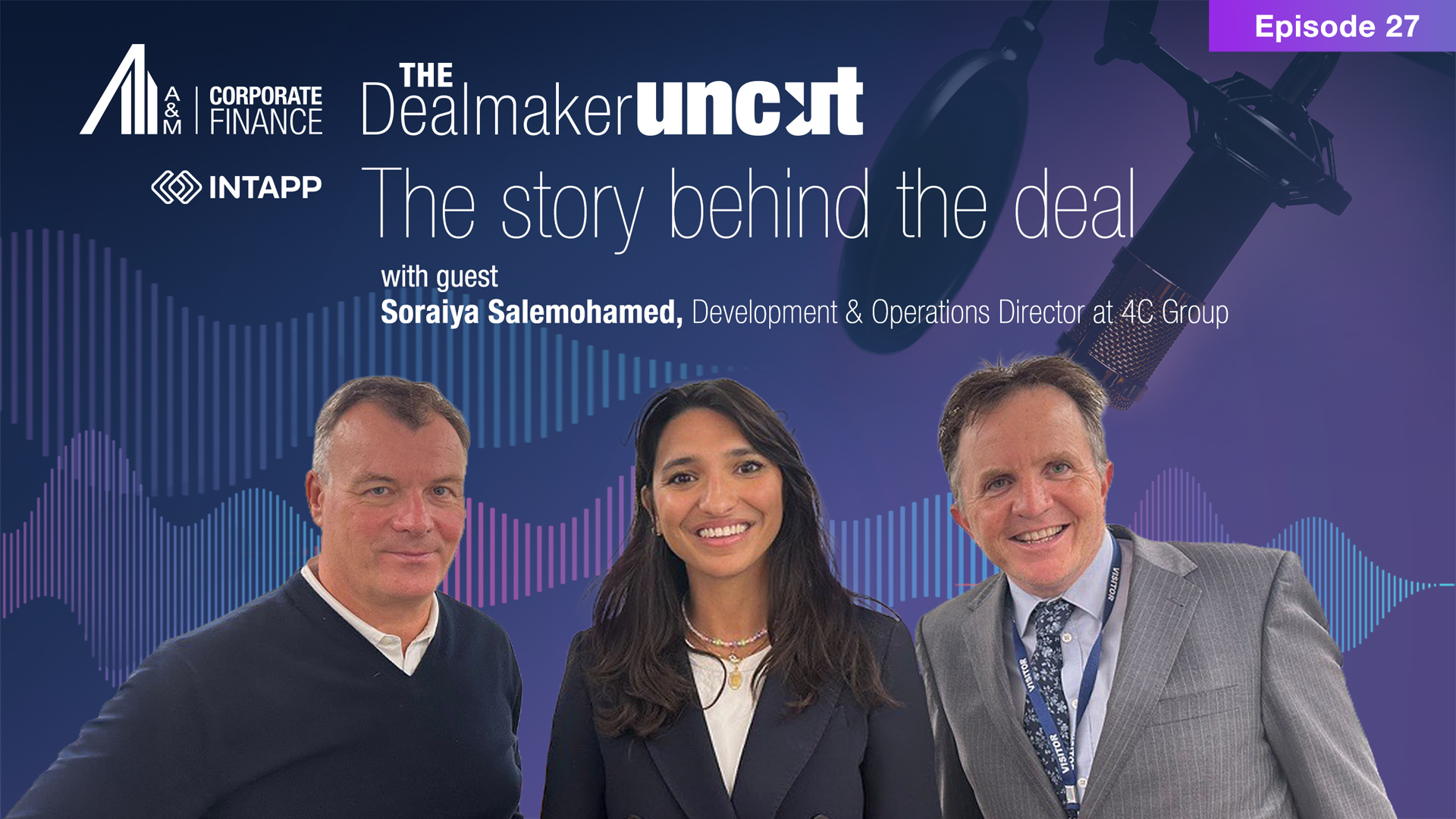
Soraya Salah Mohammed is the Development and operations director at 4C Group, a privately owned property developer and hotel operator based in London. Hello, Saraya.
[00:01:13] Speaker C: Hi. Thank you for having me here today.
[00:01:15] Speaker A: Thanks for coming here, Saraya. Whenever I come down to London, I look upwards at the sky and I'm always struck at the number of cranes there are on the skyline. Somebody said to me, if you want to see how vibrant a city is, look at the skyline and count the cranes. And the burgeoning hotel sector seems to have played a big part in the London story as well. Before we get into that though, I want to take you back a little bit. Our astute listeners and viewers will have noticed that that is not a Camden accent you've got there. You're from Canada, you've got an interest in Japanese flower arranging. But just tell us a bit about your journey to the UK, to 4C Group.
[00:01:52] Speaker C: Yeah, absolutely, yes. I'm surprised that you caught my accent.
I'm from Vancouver but I worked in tech in Canada and then I move to the UK and did my Masters at the Bartlett and then changed into property. It seemed like a very good time given that it is always continuing to succeed in London especially.
And now I've joined the 4C Group family practice.
[00:02:15] Speaker A: Now 4C Group's portfolio includes some really significant hotels, including the Western London City and Canopy by Hilton London City. We'll talk about them later, but first just tell us a bit about the major players behind the business. 4C Group was founded by Bashir Nattu and his son Al. Karim Natu is the CEO. So what can you tell us about them and the wider team?
[00:02:38] Speaker C: Yeah, so they started in the 80s primarily in the UK. They are from East Africa and since the 80s they've grown their portfolio across the UK, Canada and East Africa, primarily in hotels, but now they're going into the other living sectors, including pbsa, which is the first one in Camden.
They're going into senior living and they're going to build to rent in Canada.
[00:03:01] Speaker B: Could you give us an overview of the portfolio, just a bit more detail of the operations of 4C Group?
[00:03:09] Speaker C: Yeah, they're very unique family practice. I say unique because they're completely vertically integrated.
They acquire land, they develop it themselves and then they bring in a hotel brand from, franchise it and manage it from the get go.
So that's why they're taking a longer term position, especially in the property market, which takes a long time to realize and they've been in it for the last 40 years.
[00:03:37] Speaker B: Okay, so on this podcast we're usually talking about deals. And so what I'm interested in is just how these property deals are put together.
Maybe we use an example. So there's the Hayden, which you've told us about earlier.
So I think I'm right that 4C partnered with Regal London and raised some money from Pluto Finance. I think that was about 40, 44 million loan towards the development. There was something like 95 million.
Can you just talk us through how a deal like that is put together?
[00:04:15] Speaker C: Yeah, absolutely. So that Hayden is a very unique one and I think we talked about it in terms of it actually is part of a larger development.
So this is that long term thinking that the 4C group had, they had acquired this piece of land which includes the Canopy, the Hayden and 60 Algate, which is to be rezoned for commercial. And the City of London and 4C had worked together to find something that would offer a new type of offering for the local demographic. And so instead of building offices, they were inclined to build something that would be residential, hotel and offices later on. And so the Hayden was part of the second phase of that development.
And the reason why we got Pluto in was because the canopy was built first.
And part of the canopy development is just neighboring the Hayden and it shares a basement. And so what 4C did was during the construction of the canopy, they had built a lot of the basement already and part of the frame. So when they were looking at different financing options, lenders were way more confident in the construction of The Hayden because they knew that the city was promoting more residential and they knew that a lot of the hard work had been done already.
[00:05:34] Speaker B: What stage is the funding raised? So obviously there's from a twinkle in the eye through planning and design.
When do you actually raise the funding? Is it funding raised as the work is being done or done before?
[00:05:49] Speaker C: It really depends on cash flow and it depends on the type of asset. So for this particular one, obviously it was done in different phases and there's obviously different type of lending depending on the phase. Some lenders prefer more of the development side. They have different appetites. For this particular one, we had worked with Lumi for the Canopy, the neighboring one, and then Pluto had offered a different type of financing for the Hayden. And that they believed would work well given that they wanted to expand their residential market.
[00:06:21] Speaker B: Okay, I see.
It's funny how a modern apartment, if you look at a block of apartments compared to what they used to be. They now have gyms and yoga, they've got restaurants or cinemas. They've got, you know, they seem to be.
The evolution in what's offered in the apartment market seems to have changed dramatically Now. I'm assuming that's driven by customer demand, but can you just talk about how those things have evolved?
[00:06:55] Speaker C: Yeah, I mean, as we know, London is a very transient city.
We've got still an international client base. And actually the Hayden, before it opened, 70% was sold and a lot of them were international buyers. And that's the type of service that they're looking for. Obviously it's baked in with the service charges and everything like that. But they wanted a secure location where everything was within the same building. And I think it's also a legacy of COVID expecting everything within your remit within your residence.
[00:07:26] Speaker B: Okay. And so when you say they're sold, they're sold to occupiers or are they sold to landlords who are going to rent them out?
[00:07:34] Speaker C: So it's a bit of a mix, but it would be primarily single occupiers.
4C had actually retained a few assets for themselves, a few units. So that if we ever needed a, you know, the hotel does really well. So if we ever need another opportunity or another unit, we can go into the Hayden if in the future, if that's a possibility. So it's just future.
[00:07:53] Speaker A: I'm that person. I'm that person. Looks at rightmove to check the price of every property in about four streets where I live. If I was looking at the Hayden right now and I was thinking about Thinking, you know what, it'd be nice to have a little bolt hole in London. What's the price point for the Hayden?
[00:08:07] Speaker C: So I think it sold at that time, it completed in 2024 and it was around 1,000 per square foot.
I mean obviously now the property market has softened quite a bit. So again, very fortunate timings we came in. That's not to say that there is a longer term view. It's one of the newest assets in that corridor and so you would be valuing it at a different one because of the amenities that are up offered as well.
[00:08:32] Speaker B: So in 2021, Oak North bank, which is a sort of entrepreneurial bank, provided a 52 million pound facility to 4C Group. And I think that was to fund the Westin, which is quite a well known property.
Could you just talk a little bit about how the finances are put together just to give people an understanding of how the funding works for these, these developments?
[00:08:59] Speaker C: Yeah, so every obviously within a development, from acquisition, development to operations, it can be quite normal to have different type of financing solutions and offers. And so for the Westin, even before Oak North, 4C had actually bought the land themselves.
And so at that time they had gone through planning in 2012-20 2014, but at that time development financing was quite difficult. So, so they had restructured it through a ground rent scheme and then after, during the development part of that Oak north had come in to help with the senior debt stretch and again it's all about the different appetites, what's happening in the market and working with lenders to find a long term solution.
4C Group Works has different relationships, depending on the type of scheme, depending on what the lender wants.
Like you mentioned, Oak north is very entrepreneurial and we were very lucky to work with them on the Westin and they provided support to us for that development all the way into stabilization, which was necessary to get the Westin through.
And then they were taken over by another bank, Santander, two years after stabilization because of the needs of what that hotel had wanted.
[00:10:20] Speaker A: You can always tell tourists in London because they look up whereas Londoners look down. You know that is a complete generalization, but that's my experience and I love looking up at seeing these properties. I love the different shapes, different sizes, the contemporary styles as well. They're absolutely amazing.
Manster's amazing as well. And I mean you're a sought after speaker. You recently spoke at the annual Hospital Hospitality conference in Manchester. It's one of the marquee events for the industry and it brought together over a thousand delegates and 200 investors and owners. What was your takeaway from that event? And is hospitality still an attractive proposition for investors?
[00:10:59] Speaker C: Yeah, I mean, every year there's obviously a different sentiment. I mean, I've been going for the last five years and I just came out of COVID so there was a different messaging this year. Obviously, given the constraints of the market and the industry and what hospitality is facing with rising business rates, I wouldn't say doom and gloom, but there, there needs to be a little bit more optimism because development is so expensive, so expansion is hard, but with businesses like 4C, because we're vertically integrated, there is still an appetite to take over that management and expand within the property versus buying and buying new properties.
So the conference itself was talking about maybe repositioning the market or repositioning your asset and finding new sources of revenue. Given that you may not acquire new parcels of land and development, is there
[00:11:51] Speaker A: appetite from the investors to still fund these schemes?
[00:11:55] Speaker C: Absolutely. As you know, there are so many new hotel openings in London, especially in the ultra luxury market, so there is definitely a demand for that supply.
And London and the different boroughs are working hard to make sure that there is a consistent attraction.
The city itself has created a new scheme for tourism to support new hotels that are coming up so that with the new transport links to Heathrow, with the Elizabeth line and the city, it'll be easy for tourists to come in. And especially with the Middle east, we are still seeing strong demand of visitors, especially from the US coming to the uk.
[00:12:36] Speaker A: We might have to launch a property podcast at this rate, but London remains one of the most expensive property markets in the world. But prices you mentioned earlier certainly softened, have been falling and buyers have been a little bit more cautious. So as a developer, how difficult is it to make schemes like the Hayden stack up in the current market?
[00:12:52] Speaker C: Yeah, that's a very good question. And it's also.
[00:12:54] Speaker A: Is it better than Jonathan's question? Is that the best question?
[00:12:58] Speaker C: It just gets better and better.
It's all about timing. And with the Hayden, fortunately It finished in 2024 and had completed. So there was a lot of appetite for people to come into London.
It was still seen as a safe economic city to invest in.
Now with development, it's difficult to make that not just development costs. I mean, there was a study that had come out, excluding inflation of course, but construction costs have increased by 60% since 2015, which is a considerable amount.
Also with development and the long term planning processes that take. So when you're sitting on capital, for example, even if you've acquired land or if you want to go into development, just financing and servicing those debt fees is considerable.
[00:13:51] Speaker B: So I mean it's interesting to try and get a feel for how hard or easy it is to build property in London. So I think you were looking at building a hotel in Camden and you ended up with planning consent to build a 178 student bedroom student accommodation and 27 affordable homes.
So what does that mean? You went to, you went in to look for a hotel and ended up with that. So what does that tell us about the London property market development in London?
[00:14:29] Speaker C: Yeah, that's a very interesting take because like I mentioned, 4C have aspired to run hotels, operate and develop hotels because that's it services new assets as well. And so for that particular one on that road, Jamestown Road, they envisioned having an apartment hotel because they actually have a hotel right across the road. So there's definitely. They already saw demand, they knew there was an under supply in the market given that they have an asset across the road. So it was very fortuitous that that parcel of land had opened up and they thought, and we thought that we were able to change it to an apartment hotel and rezone it from a depot to an apartment hotel.
But going with, talking to the council of Camden, they were adamant that they needed to meet their housing targets. And of course student accommodation does, I would say have some sort of effect on private rentals for local residents.
So having a PBSA offering was a lot more appealing to the council because they needed to fulfill their housing requirements.
4C had to take a different approach.
I mean PBSA is very, I wouldn't say similar to apartment hotels. PBSA stands for sorry for Student accommodations.
It's a similar model in terms of it's a 51 or 41 week rental model. So in our mind for us to pivot not just straight to residential but to find a hybrid between the two was more attractive and we had to take our lender on that journey as well.
[00:16:08] Speaker B: But it makes it hard to plan though, doesn't it? If you think, you think you're going to do one thing and then you end up having to do something different. You have to be flexible and fast on your feet.
[00:16:16] Speaker C: Definitely. And this apartment hotel was already student. We had already planned, sorry studio. We had already planned studios.
And so luckily for us to change into the student accommodation scheme, it was a very similar layout.
[00:16:31] Speaker A: Yeah, it's about being agile, isn't it?
There's something you said that I think touches upon something that Jonathan often says to me as well. And I think there's an overlap. I mean, normally with the Dealmaker Uncut podcast, we're talking about M and A and you'll talk about whether or not there's an appetite to do deals, etc. Etc. You've spoken about the fact that over the last two years the property market has softened as well.
So much of the property market is about timing. So much of the deals market is about timing. And I would imagine as well there's probably a correlation between when the deal market is flat in terms of MA activity. I would imagine the property market is a bit softer as well. Jonathan, would that be fair?
[00:17:11] Speaker B: I think there's probably a connection, but I think the property market is probably more linked to the funding market, isn't it?
So if the situation there, where the banks are lending quite a lot of money, the M and A market's still been quite tough. So I'm not sure they're completely connected. I think they are obviously connected to economic expectations though.
So 4C has a track record of buying land and then holding it and taking a long term approach rather than just developing everything. I'm sure that's quite a common approach, but I assume that's, you know, it's partly about funding, partly about planning, partly about committing resources.
Can you just explain the strategy around holding land and when you develop it and how you make those decisions?
[00:18:05] Speaker C: Yeah, we definitely call it patient capital, especially, you know, land banking and making sure that you're seeing the potential. Obviously market factors come up for that particular. If we take the example of a larger development, the Canopy, the Hayden and 60 Algate, which will be developed later on, it was one of the largest developments that they had done.
So ensuring that they had enough liquidity to support the construction of the different phases was key. And planning obviously driven by market conditions as well, but understanding and managing cash flow.
What I mean by that is the Canopy is a hotel that they have so much experience in managing and having that cash flow to provide confidence in the other phases was the best step that they took for the beginning instead of maybe driving it from the residential element.
So their strategy there was, okay, we have this parcel of land. What is the first thing that we can make commercially viable, understand the dynamics and from the construction point of view so that you can pull it in with the other parcels.
And 4C is unique that, you know, they believe in a 60. They're quite conservative with their loan to value. It's around 60% and that's something that they're driving towards because they want to show lenders that they are confident in the market and they're taking them on the journey. But they are quite patient in developing different phases because it allows them to take the time to see if there are market conditions that come into play. And, you know, for example, the 60 Algate was zoned as a purely commercial office scheme, 250,000 square feet. I don't know if that's something that the market needs right now, but it's something that we're exploring and if we have to go back to planning, we can do that. But at least it's not a structure we've built.
[00:20:01] Speaker B: But that means you're effectively having to make assumptions or estimate what demand will be like in a. When the development's finished quite early on in the process. And one thing, demand for a hotel is different to demand for some commercial properties.
Student accommodation might be a bit more predictable, but it does sound like there's quite a lot of thought needs to go in to predict what demand will be like.
[00:20:29] Speaker C: Yeah, I mean, for the hotel side, given the.
We operate seven hotels in Greater London across five different brands.
So already there's a host of, you
[00:20:42] Speaker B: know, wealth of knowledge right there about how they're performing.
[00:20:45] Speaker C: Exactly. And data that we can pull into quite easily. So from the hotel aspect, I mean, there's always going to be a demand for tourism in the uk, especially in London. I mean, we were talking about Wimbledon. Wimbledon is maybe an hour by tube from the Canopy on the District Line.
And still we see our ADR increase quite a bit to maybe 600, where it's usually around 300, 350 around that time.
[00:21:11] Speaker A: That's the average room, isn't it, really?
[00:21:13] Speaker B: Right.
[00:21:13] Speaker C: Is it at that particular time within June and I mean, that's quite high given that Wimbledon is an hour away. But still you're seeing that impact. And when you come back to understanding and forecasting the future, obviously you're.
You're confident that the market will always pull tourism. I mean, London is such a unique city and there's so much going for it consistently combined with the data that you're getting from the different brands and understanding the type of brands that would work within that area, work within that neighborhood. For the ADR that you're trying to achieve with the lending that you're trying to achieve as well, it all kind of works together. And then the other parcels and other types of uses definitely play are supported by that anchor development.
[00:21:59] Speaker A: That's the Positive. So if Wimbledon's on, then it has a positive effect on you. But if we look at there's a lot of geopolitical events in the world at the moment.
London attracts a lot of buyers, a lot of investors and businesses from around the world. So how quickly do global events feed through to the business?
[00:22:19] Speaker C: Yes, actually during, I mean there's, we're talking about the whole world here. So it really depends on what side of the world you're on. But for example, you know, when the American elections were happening, there was a lot of uncertainty in the market that we knew and it did affect a lot of tourism and travel within London. And we saw the Canopy and Weston, Marriott and Hilton. We had a lot of our base customer are Americans so we definitely saw a lower ADR because of that.
But again it springs up quite a bit. It's just there are moments of intensity and uncertainty when those things happen and then it definitely bounces up because people still have long term plans to come here.
For example, what happened in the Middle east this year, there's still an appetite to come to the UK and actually a lot of the.
We saw certain much demand in those couple weeks because people were rerouted to actually take their layovers in London.
And there are negatives and positives depending on the geopolitical obviously with the elections on the other side and what was happening in the Middle East. But we did see that the market changed and the UK actually became a safer place to travel.
[00:23:34] Speaker A: One observation I've got about the property sector, especially developer side is the same observation I've got about the dealmaker sector, which is they tend to be dominated by men, both sectors tend to be dominated by men. You strike me as being quite unusual. Is that a fair observation and is it changing at all?
[00:23:54] Speaker C: I definitely think there are more similar faces like myself in the room.
There is a generation of family offices and generations of them being passed on to, to the future female leaders. And we're going to see a lot more of that and I'm sure you've seen that within your own interviews is that you're seeing those family offices actually being passed down to a lot of women that are taking over.
So it will take time.
It's hard being the only woman in a room sometimes, but it works to my advantage.
[00:24:32] Speaker B: We see it in corporate finances very similar that a lot of the girl, the ladies are the only lady in the room and less so as time passes. I think it's starting to open up definitely there's still a long way to
[00:24:45] Speaker C: go it is a long way to go. And I notice a lot of my panels now, they won't be just one, there won't be one female on the panel. They'll try to have at least two.
And it's expanding into networking events as well. We're seeing networking events change in terms of the types of events that the way people meet.
I think there's more of an inclination to ensure that you have a diversity of resources and a diversity of people that you're bringing in.
But there is still a long term change that needs to happen, but it's slowly happening. I do notice that there are more faces.
[00:25:19] Speaker A: Well, it's great to have you on the podcast. Massive. Thank you for your time today and sharing your insights as well. Time for a quick break. When we return, Jonathan and I will be discussing our interview with your good self before Jonathan does his bit and answers your questions. Thanks very much.
[00:25:33] Speaker B: Thanks Sariyah. Really interesting.
[00:25:35] Speaker C: Thank you for having me.
[00:25:43] Speaker A: Well, welcome back to the second half of the Dealmaker Uncut podcast. We just interviewed Sariah Salmohamed about fascinating insights about the world of property and investment. What did you think, Jonathan?
[00:25:54] Speaker B: Well, I thought it was really interesting to think about the parallels between the, the deals market that we're normally talking about and the property market and to hear a bit about the funding and the, you know, the thought processes that they go through when in putting a development together.
Yeah, really interesting.
Really interesting to hear about that.
[00:26:17] Speaker A: Yeah. I mean what's obvious listening to Sariah is she's all over her numbers and also how the market is affected by, you know, things outside of their industry as well for good and for ill.
Absolutely fascinating. And she's a much respected voice in the world of property as well. And it also makes you think in terms of there's this big movement from government to try and get developing and try and get building and try and get growth in the economy as well. But one of the things that holds construction and development back is the process is the time. And actually if a local authority hasn't hit its targets to then you might find your application for a hotel gets pivoted towards student accommodation. But really fascinating guest and actually although slightly different to what we normally do, I think it was really interesting as well. So this next section is called Ask Jonathan. It's where listeners and I can ask you any question they want. So question number one, what separates a good deal from a bad deal? And what are the biggest red flags that would make you walk away?
[00:27:18] Speaker B: Well, I suppose red flags, the Most common reason that people end up walking away from a deal is probably that trading starts to deteriorate during the later stages of a sale process. So when people have agreed a deal, often if people aren't careful, management can get distracted during the process and they take their eye off the ball and then suddenly they're not selling as much or they're not delivering as much and sales start to deteriorate and then you end up immediately with either a price chip or more commonly, a buyer or an investor will just lose faith.
So I'd say that's the most common reason. I mean, there's a whole multitude of factors what makes a good deal or a bad deal, and sometimes it's all about strategy. And if you've got a buyer that's got a strategic rationale to buy the business, then that can obviously create quite a lot of value for everybody.
But often if you've got a growing business that's got good stable income streams, then that will attract investors as well.
So it's hard to pin down one factor, but I think that is the main cause that deals fall away.
[00:28:34] Speaker A: We interviewed Tom Staff at Street Group recently and he spoke about the fact that when it comes to property markets, when people come to sell their houses and they get three estate agents, invariably they'll have three different valuations and the owner will quite often go with the highest valuation. Doesn't always work that way. And we've got a question, I think, which has been prompted by that. We hear a lot about businesses being bought at unrealistic valuations. Are buyers becoming more disciplined on price and is there still a valuation gap between buyers and sellers?
[00:29:05] Speaker B: I think there is a difference between a very, very attractive asset company that gets brought to market.
If you've got a business that's growing quickly and meets all the investment criteria that private equity houses are looking for, you'll normally get a really well attended auction and that will really often drive quite rich valuations. Even in this current market where people.
The market's been quite tough for a few years, but even in this market, an attractive asset will still attract a good price.
Sometimes when businesses are, there's either not as much strategic rationale for a deal or if the business is good but not in the top decile, then you'll still get buyers for a business. But sometimes there can be more protracted negotiation around price.
Very often when businesses go for very high prices, it's because the earnings are growing.
And so people might apply a multiple to an earnings figure to get to the value that they'll pay. Often the reason a multiple will look very high is because it's actually going to make more money than it looks like it has done in the past. So it's often really a function of the growth of the business rather than the price being exceptionally high.
[00:30:25] Speaker A: And the final question in today's episode is what makes a business generally attractive to an acquirer or an investor? And what should founders be doing two or three years before they want to sell?
[00:30:35] Speaker B: Well, a very good high quality management team that are motivated and have clarity over their vision and their plan with a good culture that would usually be a big tick in a lot of purchasers or investors boxes.
But also high quality income stream. So when a business can effectively create recurring income, either by having longer term contracts with customers or being able to prove that earnings are resilient, that customers keep coming back and don't tend to this low customer churn, that's obviously another area that makes businesses more attractive and can make them more valuable.
And there are things that management teams can do to improve the quality of their earnings if they've got time to, you know, to change their terms of trade or negotiate extended contracts with customers and such like.
[00:31:33] Speaker A: I hear that advice a lot actually. You know, invest in your management team and it does pay dividends. That's all for this episode of the Dealmaker Uncut podcast powered by Alvarez and Marcel. Final shout out to you, Jonathan.
[00:31:45] Speaker B: Thanks, Chris.
[00:31:46] Speaker A: And don't forget to subscribe to the podcast. Tell your friends and family, give us a rating and follow us on social media. My name is Crystal Grind.